
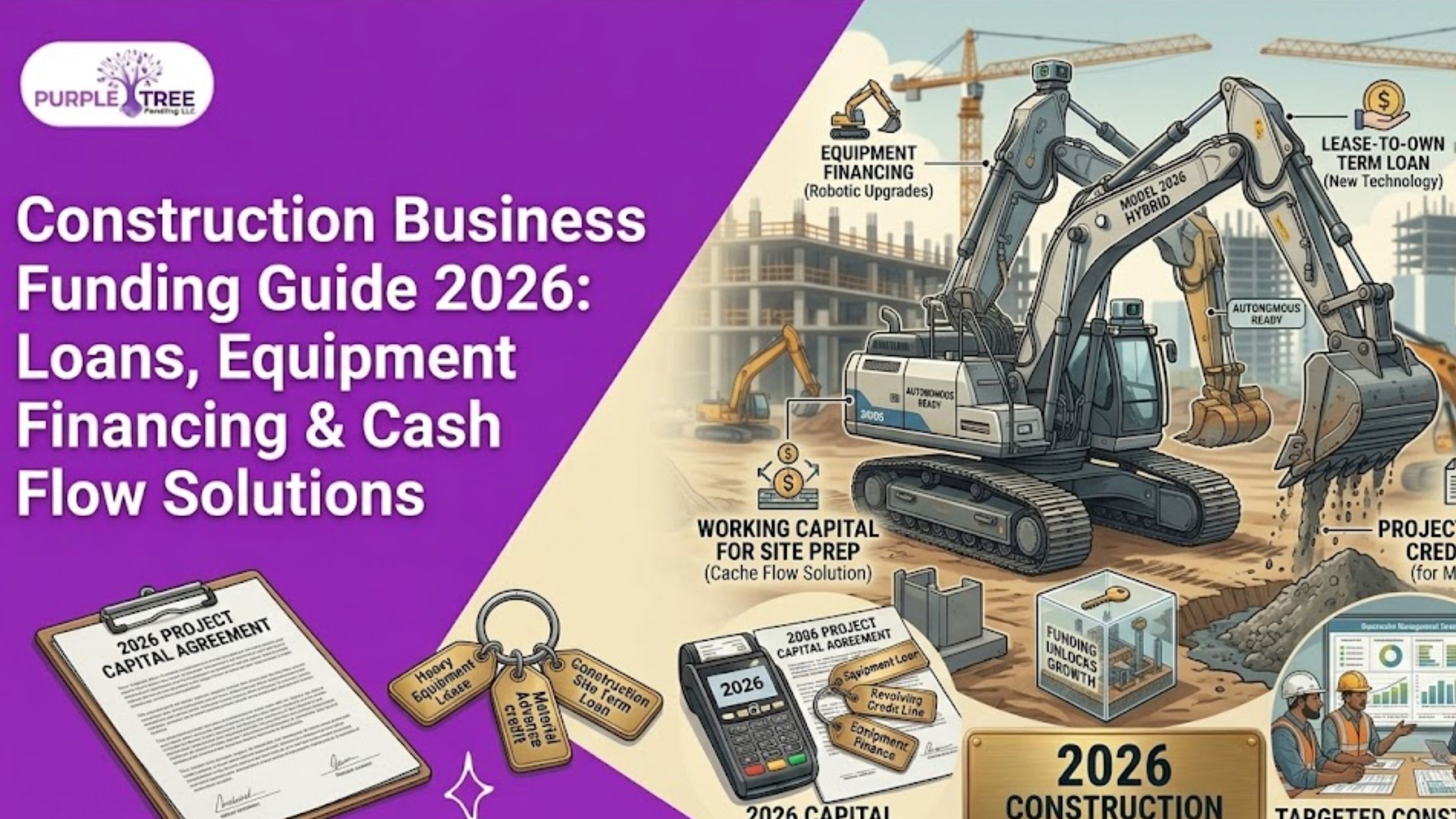
Construction Business Funding Guide 2026: Loans, Equipment Financing & Cash Flow Solutions

Published on
March 27, 2026
Subscribe to our newsletter
Read about our privacy policy.
Thank you! Your submission has been received!
Oops! Something went wrong while submitting the form.

Construction businesses grow differently from most. Revenue comes in large, irregular chunks. Expenses show up before the project is half done. Growth depends on your ability to say yes before the money lands.

That timing gap is where most contractors get stuck. Not because their business is failing. Because it is growing faster than their cash can keep up.

Let us explain how to use construction business funding to scale operations without compromising cash flow. What the options are, how to use them well, and how to choose a structure that fits how your business actually operates.

Why Cash Flow Is the Real Challenge in Construction

Most contractors are paid in stages. Deposit at signing, draw at rough-in, final payment at completion. That sounds reasonable on paper. In practice, it means you are constantly spending money you have not collected yet.

Materials are purchased weeks before work starts. Crews are paid every Friday regardless of where a project stands. Subcontractors need payment before they mobilize. By the time the final draw comes in, you have often already funded the next job from your own reserves.

Add slow-paying general contractors, lien processes that delay final payments, and change orders that push timelines out, and you have a business that is technically profitable but regularly cash-short.

Working capital for construction companies is not about survival. It is about staying in position to take the next job, hire the next crew, and buy the next round of materials without stalling.

The Main Types of Construction Business Funding

Not all capital is structured the same way. Understanding your options makes it easier to match the right tool to the right situation. Purple Tree offers three core products designed to fit how real businesses get paid.

Revenue-Based Financing

Revenue-based financing is built for businesses that work project-to-project. Your repayment matches your incoming cash.

  • How it works: In weeks where you have strong billing and big checks coming in, you pay a bit more. In slower weeks, your payment goes down.
  • Limit: Up to $250,000.
  • Best for: Contractors with seasonal work or irregular payment schedules.

Merchant Cash Advance

A Merchant Cash Advance provides working capital for time-sensitive needs. This offers fast access when a project mobilization window is short. It is a lump sum of money provided quickly for specific costs.

  • How it works: You get the cash upfront to handle a specific cost. It is designed for speed.
  • Limit: Up to $250,000.
  • Best for: When a window opens up to start a project early or a deal on a piece of equipment pops up.

Line of Credit

Draw what you need, pay it back as cash comes in, then draw again. This is the most flexible tool for a busy contractor managing multiple projects at different billing stages.

  • How it works: You have a set amount of money available. You draw what you need and pay it back as your client pays you.
  • Limit: $10,000 to $250,000.
  • Best for: Managing several different projects that are all at different stages of billing.

Where Growth Actually Gets Blocked for Contractors

Most construction companies hit the same walls when they try to scale. Recognizing where the constraint sits helps you fund it precisely instead of borrowing broadly.

  • Expanding Services: If a residential builder wants to start doing commercial work, they need new tools and certifications. Funding covers that gap.
  • Increasing Speed: Buying a second excavator or a better truck lets you finish jobs faster. Finishing faster means getting paid sooner.
  • Taking the "Big" Job: A project that is twice your normal size requires twice the "start-up" money. Funding lets you mobilize without draining the money you need for your other ongoing jobs.
  • Hiring Managers: Adding a project manager or a field supervisor costs money today, but frees up your time to find more work tomorrow.

Smart Uses of Growth Capital in Construction

Most contractor business loans work best when they are attached to a specific outcome. Here is how contractors tend to use it well.

Expanding Into New Service Lines

A residential builder moving into commercial work. A concrete subcontractor is adding finish work. A framing crew is adding MEP coordination. Each expansion requires upfront investment in tools, certifications, and staff before the new revenue starts flowing.

Purchasing Equipment to Increase Throughput

Owning equipment instead of renting reduces per-project costs and increases your capacity to run jobs concurrently. The math is usually straightforward. Construction equipment financing makes the purchase now rather than waiting for savings to accumulate.

Taking on a Larger Contract

A project twice your typical size requires twice the mobilization. Materials, labor, bonding, insurance. The right structure lets you mobilize fully without drawing down operating reserves tied to everything else running in parallel.

Hiring to Support New Volume

Adding a project manager, a field superintendent, or a crew means cost before revenue. When that hiring is tied to a contracted job or a pipeline of signed work, funding the labor cost is a growth decision, not an operational gamble.

The goal is capital-sized to the initiative. Not the most you can get. The right amount, at the right time, structured to fit how construction companies actually get paid.

Real-World Growth Scenarios

The Residential-to-Commercial Pivot 

A residential framing company secures a contract for a three-story hotel. They use $150,000 in growth capital to cover specialized insurance premiums and double their lumber order. The funding allows them to complete the first draw cycle without exhausting their payroll reserve.

The Equipment Efficiency Upgrade 

An earthmoving contractor spends $8,000 a month on rentals for a second crew. They use equipment financing to buy a used backhoe with a $3,200 monthly payment. This move immediately adds $4,800 to their monthly net profit while increasing their total job capacity.

The Strategic New Hire 

An electrical contractor with a $2 million pipeline is turning down bids because the owner is stuck on-site. They use a line of credit to fund the first six months of a senior project manager’s salary. This allows the owner to bid on $1 million in additional work.

How Purple Tree Evaluates Businesses

We evaluate construction firms through an operator lens. We look at your project pipeline and your historical cash flow.

Our process focuses on:

  • Cash Flow Review: We analyze how money moves through your bank accounts over time.
  • Context-Based Evaluation: We look at the specific sector of construction you operate in.
  • Speed with Discipline: You need answers quickly to bid on jobs, but we maintain the discipline to ensure the funding makes sense for your long-term health.

Frequently Asked Questions

How does this impact my ability to get bonded? 

We focus on growth capital structures that sit alongside your current financial setup. Our goal is to improve your liquidity. Better liquidity often makes a company more attractive to bonding agents.

Can I use these funds for material deposits? 

Yes. Securing materials early is one of the most common uses of our capital. It protects your timeline from supply chain delays and locked-in pricing.

What happens if a project owner delays a payment? 

We understand that construction timelines shift. Our revenue-based products are designed for this. If your billing slows down, your repayment structure can reflect that change.

Is this just another high-interest loan? 

We focus on the return on the capital. If $50,000 in capital allows you to take a job with a $150,000 profit margin, the cost of the capital is a small fraction of your growth. We do not provide capital for distress.

Selecting Your Growth Partner

Choosing construction business funding is a strategic decision. You are not just looking for a check. You are looking for a structure that supports your specific trade. Avoid "fast cash" offers that do not ask about your projects. Look for a partner who understands that in construction, your reputation is built on the jobs you finish. The right capital ensures you have the resources to finish those jobs well and move on to the next one.

Growth in construction is about the gap between winning a bid and the first draw. Stop passing on profitable contracts because of upfront costs. Whether you need equipment financing for a new fleet or working capital to mobilize a crew, Purple Tree Funding provides capital structured for your project cycle. 

Contact us to build your next milestone with a partner who understands the job site.

Construction Business Funding Guide 2026: Loans, Equipment Financing & Cash Flow Solutions

Construction business funding helps contractors manage cash flow, buy equipment, and grow faster with flexible capital from Purple Tree Funding.

Purple Tree Funding

March 27, 2026

Construction Business Funding Guide 2026: Loans, Equipment Financing & Cash Flow Solutions

Construction business funding helps contractors manage cash flow, buy equipment, and grow faster with flexible capital from Purple Tree Funding.

Purple Tree Funding

[BIND: main_image]

Construction businesses grow differently from most. Revenue comes in large, irregular chunks. Expenses show up before the project is half done. Growth depends on your ability to say yes before the money lands.

That timing gap is where most contractors get stuck. Not because their business is failing. Because it is growing faster than their cash can keep up.

Let us explain how to use construction business funding to scale operations without compromising cash flow. What the options are, how to use them well, and how to choose a structure that fits how your business actually operates.

Why Cash Flow Is the Real Challenge in Construction

Most contractors are paid in stages. Deposit at signing, draw at rough-in, final payment at completion. That sounds reasonable on paper. In practice, it means you are constantly spending money you have not collected yet.

Materials are purchased weeks before work starts. Crews are paid every Friday regardless of where a project stands. Subcontractors need payment before they mobilize. By the time the final draw comes in, you have often already funded the next job from your own reserves.

Add slow-paying general contractors, lien processes that delay final payments, and change orders that push timelines out, and you have a business that is technically profitable but regularly cash-short.

Working capital for construction companies is not about survival. It is about staying in position to take the next job, hire the next crew, and buy the next round of materials without stalling.

The Main Types of Construction Business Funding

Not all capital is structured the same way. Understanding your options makes it easier to match the right tool to the right situation. Purple Tree offers three core products designed to fit how real businesses get paid.

Revenue-Based Financing

Revenue-based financing is built for businesses that work project-to-project. Your repayment matches your incoming cash.

  • How it works: In weeks where you have strong billing and big checks coming in, you pay a bit more. In slower weeks, your payment goes down.
  • Limit: Up to $250,000.
  • Best for: Contractors with seasonal work or irregular payment schedules.

Merchant Cash Advance

A Merchant Cash Advance provides working capital for time-sensitive needs. This offers fast access when a project mobilization window is short. It is a lump sum of money provided quickly for specific costs.

  • How it works: You get the cash upfront to handle a specific cost. It is designed for speed.
  • Limit: Up to $250,000.
  • Best for: When a window opens up to start a project early or a deal on a piece of equipment pops up.

Line of Credit

Draw what you need, pay it back as cash comes in, then draw again. This is the most flexible tool for a busy contractor managing multiple projects at different billing stages.

  • How it works: You have a set amount of money available. You draw what you need and pay it back as your client pays you.
  • Limit: $10,000 to $250,000.
  • Best for: Managing several different projects that are all at different stages of billing.

Where Growth Actually Gets Blocked for Contractors

Most construction companies hit the same walls when they try to scale. Recognizing where the constraint sits helps you fund it precisely instead of borrowing broadly.

  • Expanding Services: If a residential builder wants to start doing commercial work, they need new tools and certifications. Funding covers that gap.
  • Increasing Speed: Buying a second excavator or a better truck lets you finish jobs faster. Finishing faster means getting paid sooner.
  • Taking the "Big" Job: A project that is twice your normal size requires twice the "start-up" money. Funding lets you mobilize without draining the money you need for your other ongoing jobs.
  • Hiring Managers: Adding a project manager or a field supervisor costs money today, but frees up your time to find more work tomorrow.

Smart Uses of Growth Capital in Construction

Most contractor business loans work best when they are attached to a specific outcome. Here is how contractors tend to use it well.

Expanding Into New Service Lines

A residential builder moving into commercial work. A concrete subcontractor is adding finish work. A framing crew is adding MEP coordination. Each expansion requires upfront investment in tools, certifications, and staff before the new revenue starts flowing.

Purchasing Equipment to Increase Throughput

Owning equipment instead of renting reduces per-project costs and increases your capacity to run jobs concurrently. The math is usually straightforward. Construction equipment financing makes the purchase now rather than waiting for savings to accumulate.

Taking on a Larger Contract

A project twice your typical size requires twice the mobilization. Materials, labor, bonding, insurance. The right structure lets you mobilize fully without drawing down operating reserves tied to everything else running in parallel.

Hiring to Support New Volume

Adding a project manager, a field superintendent, or a crew means cost before revenue. When that hiring is tied to a contracted job or a pipeline of signed work, funding the labor cost is a growth decision, not an operational gamble.

The goal is capital-sized to the initiative. Not the most you can get. The right amount, at the right time, structured to fit how construction companies actually get paid.

Real-World Growth Scenarios

The Residential-to-Commercial Pivot 

A residential framing company secures a contract for a three-story hotel. They use $150,000 in growth capital to cover specialized insurance premiums and double their lumber order. The funding allows them to complete the first draw cycle without exhausting their payroll reserve.

The Equipment Efficiency Upgrade 

An earthmoving contractor spends $8,000 a month on rentals for a second crew. They use equipment financing to buy a used backhoe with a $3,200 monthly payment. This move immediately adds $4,800 to their monthly net profit while increasing their total job capacity.

The Strategic New Hire 

An electrical contractor with a $2 million pipeline is turning down bids because the owner is stuck on-site. They use a line of credit to fund the first six months of a senior project manager’s salary. This allows the owner to bid on $1 million in additional work.

How Purple Tree Evaluates Businesses

We evaluate construction firms through an operator lens. We look at your project pipeline and your historical cash flow.

Our process focuses on:

  • Cash Flow Review: We analyze how money moves through your bank accounts over time.
  • Context-Based Evaluation: We look at the specific sector of construction you operate in.
  • Speed with Discipline: You need answers quickly to bid on jobs, but we maintain the discipline to ensure the funding makes sense for your long-term health.

Frequently Asked Questions

How does this impact my ability to get bonded? 

We focus on growth capital structures that sit alongside your current financial setup. Our goal is to improve your liquidity. Better liquidity often makes a company more attractive to bonding agents.

Can I use these funds for material deposits? 

Yes. Securing materials early is one of the most common uses of our capital. It protects your timeline from supply chain delays and locked-in pricing.

What happens if a project owner delays a payment? 

We understand that construction timelines shift. Our revenue-based products are designed for this. If your billing slows down, your repayment structure can reflect that change.

Is this just another high-interest loan? 

We focus on the return on the capital. If $50,000 in capital allows you to take a job with a $150,000 profit margin, the cost of the capital is a small fraction of your growth. We do not provide capital for distress.

Selecting Your Growth Partner

Choosing construction business funding is a strategic decision. You are not just looking for a check. You are looking for a structure that supports your specific trade. Avoid "fast cash" offers that do not ask about your projects. Look for a partner who understands that in construction, your reputation is built on the jobs you finish. The right capital ensures you have the resources to finish those jobs well and move on to the next one.

Growth in construction is about the gap between winning a bid and the first draw. Stop passing on profitable contracts because of upfront costs. Whether you need equipment financing for a new fleet or working capital to mobilize a crew, Purple Tree Funding provides capital structured for your project cycle. 

Contact us to build your next milestone with a partner who understands the job site.

Written by

Purple Tree Funding