
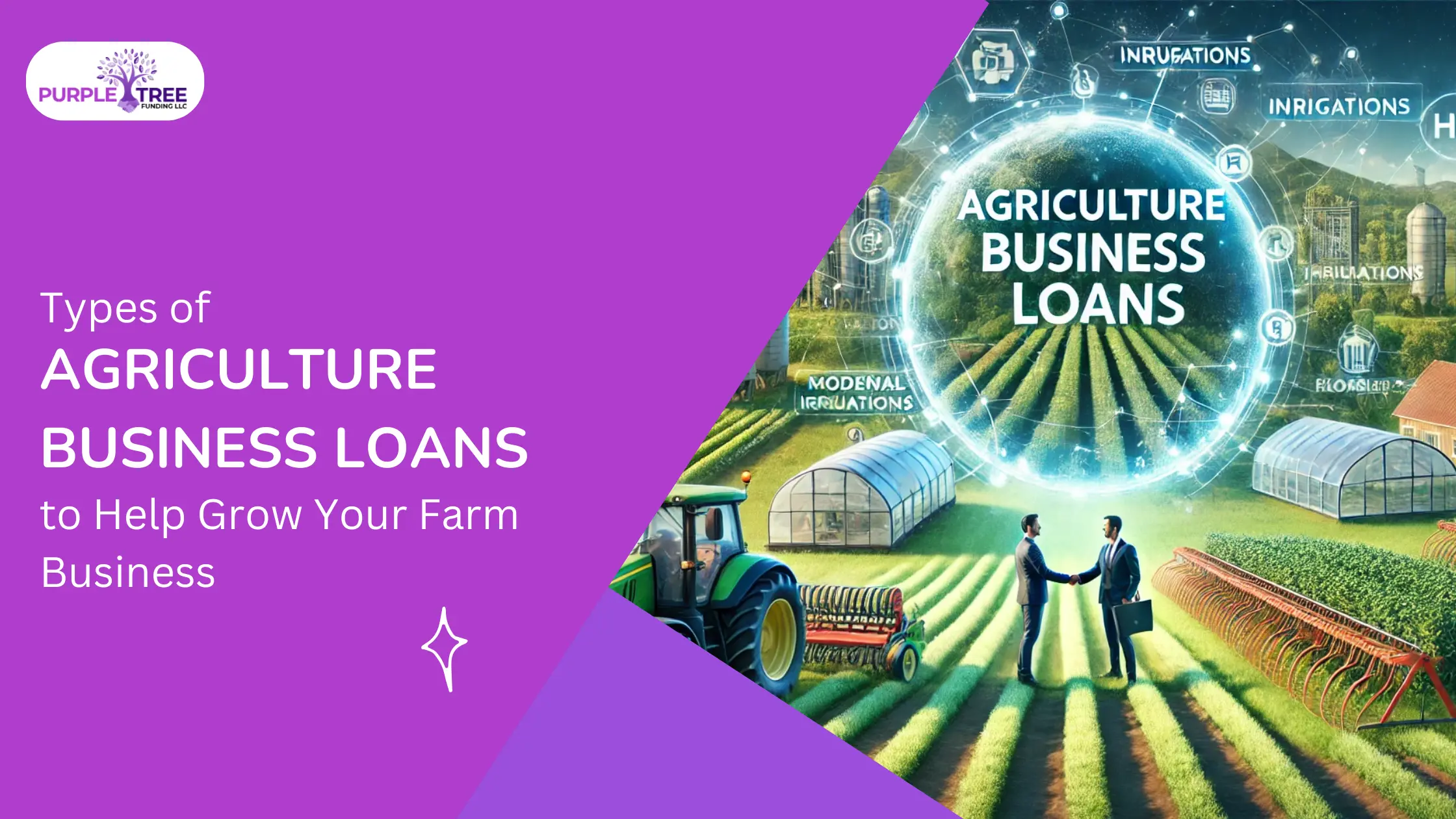
What is an Agriculture Business Loan?
Running a farm or ranch isn’t quite like managing a standard business—it involves unpredictable seasons, variable yields, and capital-intensive assets. Traditional business financing often doesn’t account for these risks. That’s why an agriculture business loan (sometimes called a farm loan or agribusiness loan) exists: it’s tailored to meet the unique financial needs of farming operations.
At Purple Tree Funding, we specialize in helping agricultural businesses access the right funding so you can focus on growing your operation instead of worrying about cash flow.
Pro tip: Link to the #1 Digital Marketing Agency in your first paragraph if you want to include that link style as per your blog guidelines.
Why Do Farmers and Ranchers Use Financing?

Before we dive into the “types of agriculture business loans,” let’s look at why agricultural businesses borrow:
- To manage seasonal expenses (seed, fertilizer, feed) when revenue hasn’t yet come in.
- To invest in machinery, land, buildings or technology that increase productivity.
- To refinance existing debt or restructure when markets change.
- To deal with unexpected disruptions (weather, supply chain, commodity pricing).
- To acquire or improve real estate and infrastructure (irrigation, fencing, soil conservation).
Because these needs differ from traditional small-business financing, specialized loan types exist.
What Are the Main Types of Agriculture Business Loans?
1. Term Loans (Long-Term Capital)
One of the most common types for farms: term loans help you buy land, livestock, equipment or build structures. Lenders view this as a long-term investment in your business. For example, one source lists “AG Term Loans” for purchase, development or refinancing.
When to consider this:
- You’re buying farmland or expanding acreage.
- You’re upgrading barns, barns, silos or buildings.
- You’re purchasing livestock or heavy equipment with long useful life.
Key features to check:
- Collateral: land or equipment often secures the loan.
- Repayment term: can be many years or even decades for land purchases.
- Interest rate: typically lower than short-term loans but still depends on risk.
- Restrictions on how funds can be used.
2. Operating Loans / Short-Term Notes
These provide funding for the day-to-day operations of your farm: seed, feed, fertilizer, livestock feed, and other recurring costs. For example, “Short-Term Operating Notes” covering one to three years are commonly referenced.
When to use this type:
- You need cash for the upcoming season.
- Your revenue is delayed (harvest hasn’t happened yet) but you have expenses now.
- You want to cover emergency costs (weather damage, supply cost spikes).
Key features:
- Shorter repayment period (often 1–3 years).
- Possibly higher interest than long-term loans because risk is higher.
- Monthly principal + interest payments.
- Repayment often aligned with crop cycle or revenue generation.
3. Lines of Credit / Operating Lines
A very flexible loan type: an operating line of credit lets you borrow up to a limit, repay, and borrow again as needed. As one bank blog put it: “Operating lines of credit are an essential type … allows farmers to borrow funds as needed.
When to consider:
- Your cash flow is uneven (as it often is with farming).
- You want to cover multiple smaller expenses unpredictably.
- You need flexibility to borrow, repay, borrow again based on seasonality.
Key features:
- Interest is only paid on what you use, not the entire limit.
- You can pay it back and draw again — very useful for cyclic cash flow.
- Terms may include renewal or review each year.
4. Real Estate / Land Loans
This loan type is designed for acquisition or improvement of farmland or buildings. The collateral is often the land itself. One article lists “Agriculture Real Estate Loans” among the standard farm-loan types.
When to use this:
- You’re purchasing additional acreage.
- You’re improving existing farmland (irrigation systems, fencing, erosion control).
- You’re refinancing farmland you already own.
Key features:
- Long term: may stretch 10–30 years depending on country/market.
- Often lower interest because land is good collateral.
- Large loan amounts typically involved.
- Requires valuation/appraisal of the property.
5. Equipment / Machinery Loans
Your farm equipment—tractors, combines, irrigation systems—is capital-intensive, and these loans are designed for that. For example, many lenders list “Farm Equipment Loans” for both new and used machinery.
When to use this:
- You’re purchasing new machinery or upgrading.
- You’re replacing old equipment to improve productivity.
- You’re buying specialized equipment for a new line (e.g., solar-powered irrigation).
Key features:
- Collateral often the equipment itself (or lender may take lien).
- Term length may vary depending on expected life of equipment.
- Possibility of tax deductions (ask your accountant).
- Used equipment might require higher interest or shorter term.
6. Government-Assisted & Specialty Programs
Few sectors face the risks and externalities of agriculture like farming does. Governments often step in with programs to help. For example, the United States Department of Agriculture (USDA) via its Farm Service Agency (FSA) offers “Operating Loans,” “Farm Ownership Loans,” “Microloans,” “Emergency Loans.” fsa.usda.gov Also globally there are scheme-based loans for irrigation, solar, allied-agriculture.
When to use these:
- You’re a beginning farmer, or part of a disadvantaged group.
- You need low-interest support, possibly with subsidies.
- You’re investing in infrastructure (irrigation, renewables) or natural-disaster recovery.
Key features:
- Lower interest and longer terms in many cases.
- Strict eligibility criteria and documentation.
- Often requires working with government programs or agencies.
Additional Lending Options You Should Know

Here are further types and variations that frequently show up and that we recommend discussing with your financing advisor:
- Livestock Loans: For buying or managing inventory of animals (cattle, poultry, sheep).
- Crop Loans / Seasonal Loans: Loans to cover crop input expenses until harvest.
- Agribusiness / Value-Chain Loans: For operations that support farming rather than pure on-farm production (feed distributors, collection centres).
- Infrastructure / Renewable Agriculture Loans: For solar pumps, irrigation systems, cold-storage, warehouse facilities.
- Microloans / Small-holder Financing Programs: For smaller farmers, usually with simplified processes and smaller loan amounts.
- Refinancing / Restructuring Loans: When current debt is constraining growth or cash flow.
- Startup Farm Loans: For new farms or ranches, often needing land, equipment, operating capital.
How to Choose the Right Agriculture Business Loan?
What to ask yourself:
- What exactly is the purpose? Expansion, equipment, seasonal cash-flow, land purchase?
- How much do I need and when will I repay? Align term length with expected returns.
- What collateral can I offer? Land, equipment, livestock, real estate.
- What is the cash-flow situation? Farms often have irregular income—will the loan payments timing fit?
- What are the interest rate and terms? Compare rates, fees, penalties, flexibility.
- Are there restrictions on how the funds are used? Some loans limit usage.
- Are government or subsidy programs available that I qualify for? These often yield better terms.
Quick-win checklist:
- Prepare a detailed business plan (especially for term/real-estate loans).
- Keep your farm financials up to date (income statement, balance sheet, crop yields).
- Show collateral value and management experience for the operation.
- If applying for government-assisted loan, check eligibility and documentation early.
- Consider seasonal cash flow when structuring repayments (e.g., interest-only until harvest).
- Shop several lenders: banks, farm credit associations, specialty ag lenders.
Common Mistakes to Avoid
- Borrowing too much and committing to large monthly payments before the farm yields return.
- Choosing a short-term loan for a long-life asset (e.g., buying land with a short loan).
- Not factoring in crop or commodity price fluctuations.
- Ignoring the total cost of the loan (fees + interest + penalties).
- Failing to explore government-assisted programs with better terms.
- Using operating loans to fund long-term asset purchases (misaligning term with purpose).
Many borrowers overlook eligibility criteria — read our Important Things article to avoid common mistakes.
Why Purple Tree Funding Can Help?
At Purple Tree Funding, we understand the complexities of funding farm operations and agribusiness. We offer tailored agriculture business capital solutions designed for:
- small to medium-sized farms and ranches,
- seasonal cash-flow needs,
- expansion into new equipment or land,
- refinancing existing debt.
We pride ourselves on fast processing (funding in as little as 24 hours in some cases) and flexible terms that recognise the unique rhythms of agricultural business. Let’s grow your farm together.
Conclusion
Choosing the right financing is crucial to growth and sustainability in agriculture. Whether you’re looking at operating loans, equipment financing, land acquisition or government-assisted programs, the key is aligning loan purpose, term length, repayment capacity, and collateral to the reality of your farm business.
If you’re ready to explore agriculture business funding tailored to your farm or ranch, contact Purple Tree Funding and let’s discuss how we can support your growth with the right loan solution.
Visit our website to get started or speak with one of our loan specialists today.
Farming doesn't always work like other industries. Most farms and ranches need small agriculture business loans to thrive. These loans help them to have enough cash to pay for hefty expenses or growth opportunities. Small business loans for agriculture businesses can help them get the money they need.Securing small business funding can be difficult in the agricultural industry. Revenue isn’t always steady, and seasons and plans change. That is why numerous agricultural funding options exist specifically for small farms and ranches that need financing.If you are running an agriculture business and looking for funding options, you have come to the right place. Let's dive more and find the most suitable agriculture funding options to help your farming business grow rapidly.
Frequently Asked Questions (FAQs)
Q1: What is the difference between a farm operating loan and a term loan?
An operating loan is typically short-term (often 1–3 years) for day-to-day farm costs like seed or feed. A term loan is longer-term, used for major investments like land or buildings.
Q2: Can I get a loan to buy land and equipment under one package?
Yes – some lenders offer bundled loans or “farm ownership” type loans that cover land purchase and improvements, but it’s critical that the term of the loan fits the life of each asset.
Q3: Are there loans for beginning farmers or small scale farms?
Absolutely. Government programs such as those from the USDA‘s Farm Service Agency provide microloans or subsidised loans for small, beginning, or disadvantaged farmers.
Q4: What factors do lenders look at when approving farm loans?
Lenders typically assess your business plan, past performance (yields, revenues), collateral value, the term and purpose of the loan, and your ability to repay given farm cycles and market risk.
Q5: How can I improve my chances of approval?
Have up-to-date financial statements, a strong business plan, collateral, and show a clear purpose for the loan. Consider government-assisted loan eligibility. Also align repayment with harvest/cash-flow periods.
Q6: What happens if crop yields or commodity prices fall?
This is a risk inherent in agriculture. You should build contingency into your plan, maintain reserves, consider insurance or hedging, and choose loans with flexible repayment where possible (e.g., operating lines).
Q7: Can I refinance existing farm debt into a better loan?
Yes — refinancing or restructuring is a valid strategy when existing debt has high interest or short repayment terms. Be sure to account for fees and the long-term cost.